
Nothing worth saving
Every so often you open up a client’s website, poke around for ten minutes, and realise there is nothing worth saving. Not the design. Not the content. Not the code underneath it. You are not renovating a house, you are standing in a condemned building deciding which wall to knock down first.
That was Enfield Smiles.
This is the next instalment in the series where I show you, in public, exactly what we are doing to turn a tired local dental practice into something that ranks. So far we have covered the Google Business Profile overhaul that cleaned up the practice’s presence on the map, and the review engine that pulled its rating up off the floor. This part is bigger. This is the one where we stop patching and start again, because the owners do not run one practice, they run three, and it finally made sense to build them a proper home.
So pull up a chair. This is how you drag a business into 2026.
Local SEO in Enfield
Want a realistic timeline for your business?
Tell us your category and where you are starting from, and we will map out what to expect across EN1 to EN3.
The post-mortem: what a dead website actually looks like
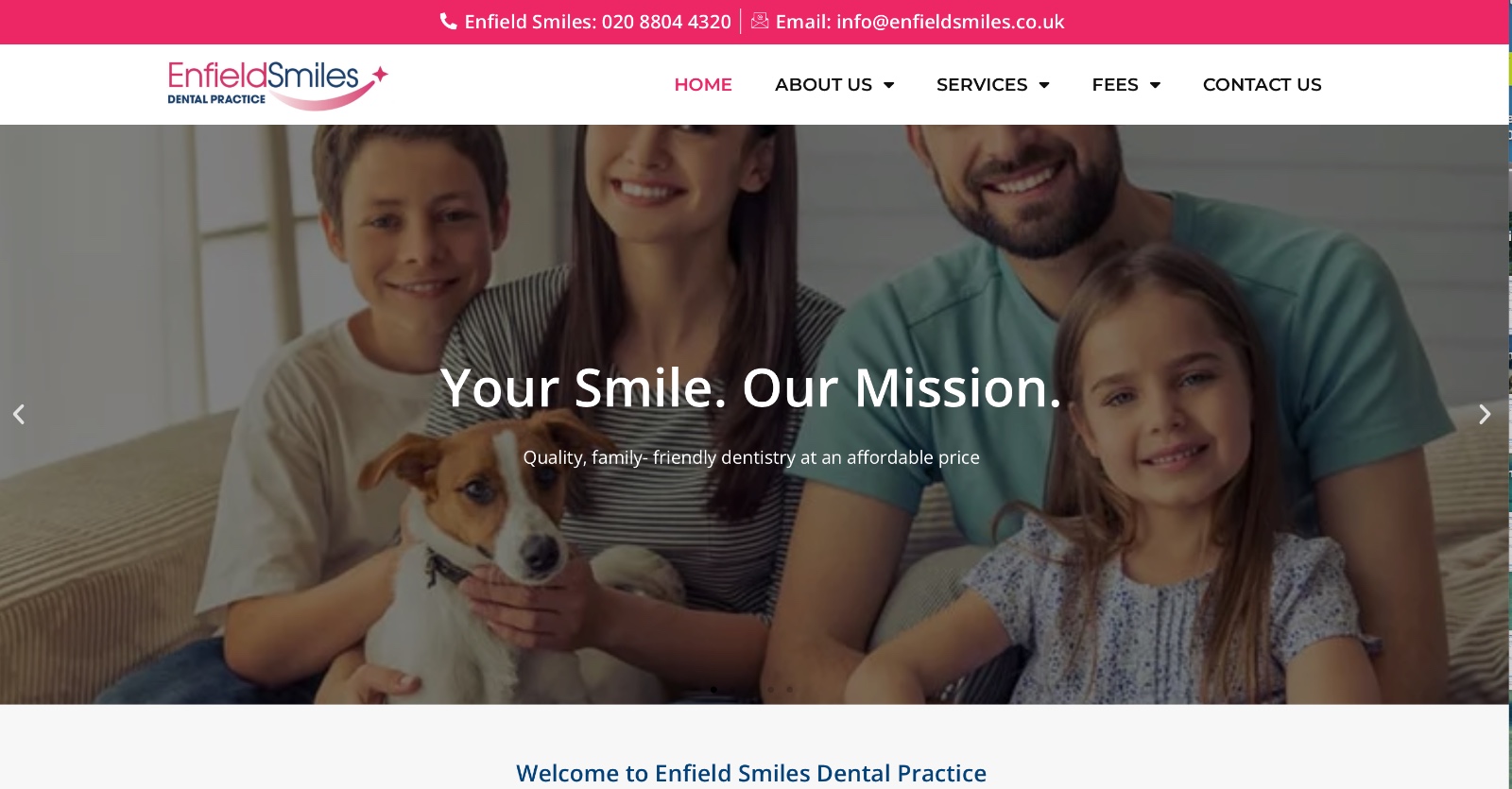
I want to be fair to the old Enfield Smiles site, so let me start with what it did right. It existed. It had a phone number. It had a real practice behind it that has been treating families in Ponders End for decades.
That is the end of the nice bit.
The footer said "Copyright 2022". That is not a small detail. A copyright year is the closest thing a website has to a best-before date, and this one had been sitting untouched while three years of Google algorithm updates rolled straight over the top of it. The whole thing was built in Elementor, the WordPress page builder that makes a site quick to throw up and slow to load forever after.
Then it got worse, and this is my favourite part.
The homepage footer had a tidy little "Quick Links" menu: Home, About, Fees, Contact. Sensible. Except every one of those links pointed at a domain called freelancinginstructor.com. Not a dental site. Not their site. Somebody’s freelance course template, wired straight into the footer by whoever built the thing, and left there for years while real patients clicked links that took them nowhere useful. Nobody noticed. That is what a neglected website looks like from the inside. It is not dramatic. It is just quietly broken in ways the owner never sees because the owner never clicks their own footer.
The rot was structural, not cosmetic:
- The navigation lied to people. "Dental Hygiene" in the footer sent you to the cosmetic page. "Teeth Whitening" sent you to the about-us page. Links that do not go where the anchor text promises are bad for humans and bad for Google, and there were several.
- There was a spelling mistake baked into a compliance link. "Complaints Precedure". For a medical business regulated by the CQC, that is not a great look sitting in the footer of every single page.
- The testimonials were a wall of unformatted text pasted onto the homepage with no review markup, no structure, and no source Google could actually read. Real reviews from real patients, presented in the one way that gets you zero credit in search.
- The homepage led with the single most self-sabotaging sentence a private dental practice can publish: a banner announcing they were only accepting new patients under 18. That one line is the NHS dental access crisis in miniature, and it was the first thing an adult in pain searching for a dentist would read. Every emergency patient, every implant enquiry, every Invisalign lead, greeted at the door with "not you, sorry".
Why we rebuilt instead of refreshed
Under all of it, the site targeted three service pages in total. NHS treatment, cosmetic, general dentistry. One location. Zero pages built to catch anyone searching for a specific treatment in a specific town. You do not fix that. You bury it.
People always ask why we do not just "freshen it up". Cheaper, faster, less scary. Here is the honest answer.
A refresh inherits every decision the old build made. The slow page builder stays. The tangled URL structure stays. The technical debt stays, you have just painted over it. You spend weeks fighting somebody else’s architecture and end up with a slightly nicer version of the wrong thing.
More importantly, a refresh could not solve the actual problem, because the actual problem was not the website. It was the business shape.
The owners of Enfield Smiles also own Nuffield Dental Practice and Church Langley Dental, both in Harlow. Three practices, each with its own little footprint online, each competing for attention on its own, each accumulating a bit of authority that helped none of the others. Three weak signals instead of one strong one. In SEO terms that is the worst of every world. You are splitting your effort across three front doors and wondering why none of them get noticed.
So we did not build a website. We built a group.
One brand, three practices, one domain doing the heavy lifting
The new home is Minti Dental Group. Under that single roof sit all three practices: Nuffield and Church Langley in Harlow, Enfield Smiles in Enfield. I walked through the naming, the brand and the multi-location architecture in the rebrand write-up, so I will not repeat all of it here. What matters for this part is why it changes the SEO game entirely.
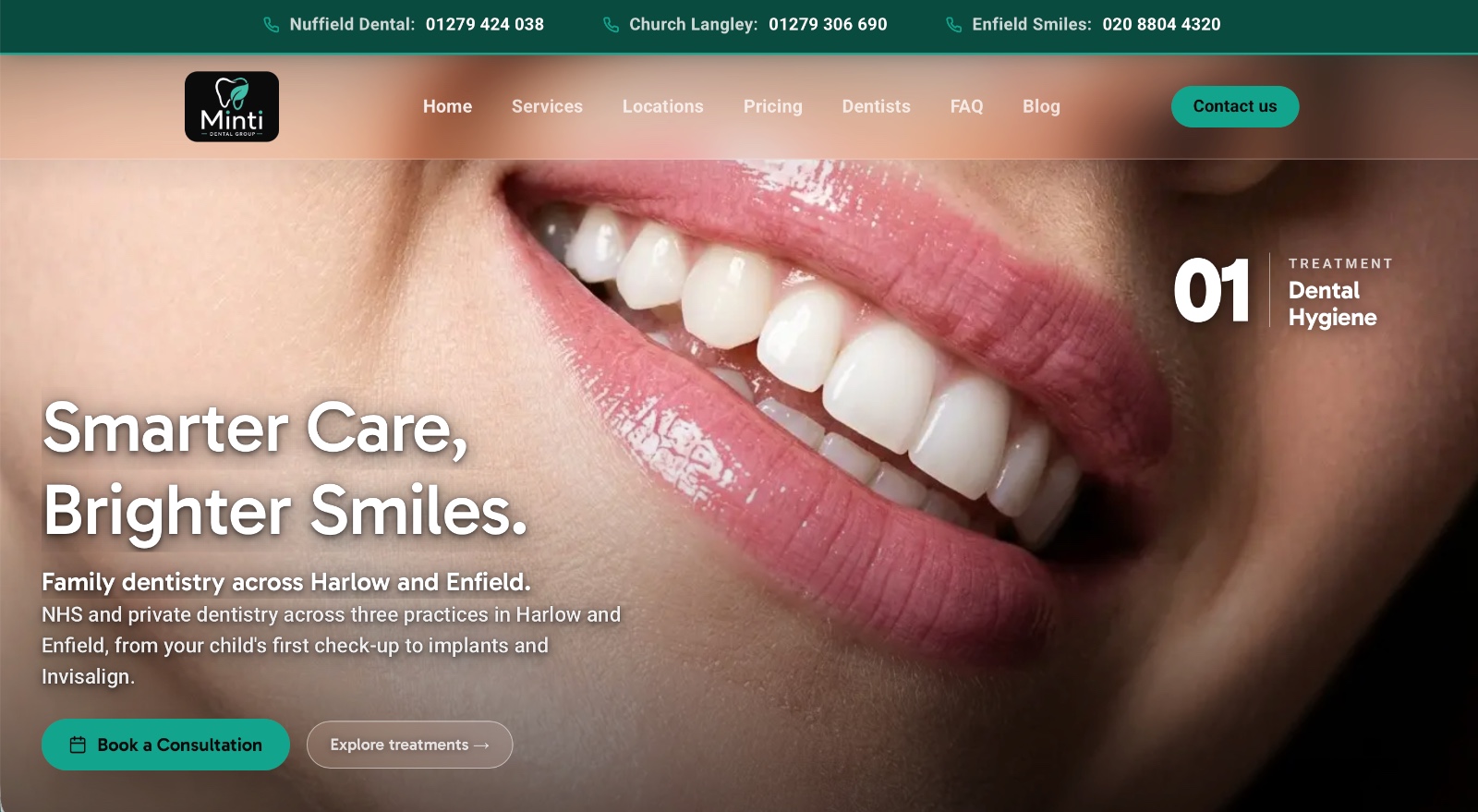
The strategic logic is simple. Every scrap of trust, every link, every piece of content, every review now feeds one domain instead of being scattered across three. Google gets one clear, well-fed entity to understand and rank, rather than three anaemic ones fighting for scraps. Consolidation is not just tidier, it compounds.
And to be clear, this is not about erasing the individual practices. Each one keeps its own name, its own phone number, and its own Google Business Profile, because in the map pack, local presence per location is gold and you never throw that away. Someone searching in Harlow still finds the Harlow practices on the map. What changes is that the organic muscle, the pages that rank in the blue links for the treatments people search, all pull in the same direction now.
One brand out front. Three practices underneath. One domain doing the work of three.
The actual play: a service times location matrix
Here is where the SEO gets real, and here is the bit worth stealing if you run any multi-location local business.
People do not search for "dentist". They search for "dentist Enfield", "emergency dentist Enfield", "Invisalign Harlow", "dental implants Harlow". Treatment plus town. That is the pattern, and it is remarkably consistent across every local service niche I have ever worked in.
So we build a page for it. Every treatment, crossed with every town.
The new site runs twelve core treatment pages: check-ups, hygiene, implants, Invisalign, composite bonding, whitening, emergency, root canal, crowns, bridges, dentures, and children’s dentistry. Then it runs location hubs, one for Harlow and one for Enfield, each targeting the big head term for that town, "dentist in Harlow" and "dentist in Enfield".
Then you multiply them together. A page for emergency dentist in Enfield. A page for Invisalign in Harlow. A page for dental implants in Harlow. Each one purpose-built to answer one specific search, in one specific place, rather than hoping a generic homepage somehow ranks for everything.
That crossover, treatment times town, is the whole game. It is how you go from one homepage praying for scraps to a grid of pages that each own their own little search, and together carpet the results for the entire area.
And the crown jewel in that grid is emergency dentist. Enfield, like most of the country, is in the middle of an NHS dental access collapse. The old site literally advertised it by turning adults away at the door. When people cannot get an NHS appointment and they are in pain, they open Google and they type "emergency dentist near me". That is the highest-intent, highest-value search in the entire niche, and we have built a dedicated page for it in every town the group covers.
What "2026" actually means under the bonnet
Dragging a business into 2026 is not about a mint-green colour scheme, although the new one does look sharp. It is about the things patients never see and Google never forgets.
The new site is built on a modern framework, not a page builder, so it loads fast and stays fast. Speed is not a nice-to-have anymore, it is a ranking factor and a conversion factor at the same time. A patient in pain does not wait four seconds for your homepage to assemble itself.
The content is crawlable. The old site had key information hidden behind JavaScript tabs and toggles, which is a lovely way to make sure Google never reads your best material. On the new build, the words are on the page, in the code, where search engines and the new wave of AI answer tools can actually see them and quote them. In 2026, being the source that gets pulled into an AI overview matters as much as being the blue link underneath it.
Every page carries proper social and structured markup, so when a link gets shared it looks like a real business, and when Google reads it, it understands what the page is and who it belongs to.
And we published the fees. Actual pricing, on the site, with a written quote promised before any treatment starts. Transparency is not just good manners, it is a ranking and trust signal, and it filters out the tyre-kickers before they ever call reception. The old site made you email to find out anything. The new one tells you upfront.
The reviews we rebuilt in the review engine part now live inside this proper structure too, instead of being dumped as raw text on a homepage. Same reviews, finally working for the business instead of just sitting there.
Where we are right now, honestly
I am not going to insult you with vanity metrics, because it would be dishonest to show you rankings for a site this new. The build is live but not finished. Some location and service combinations are still being written, the blog is only just getting going, and the redirects from the old Enfield Smiles pages need to be mapped carefully so we hand every scrap of the old site’s history to the new one rather than binning it.
What I can tell you is what we are watching. Indexation of the new service times location pages. Whether "emergency dentist Enfield" and "dentist Harlow" start to move. Whether the consolidated domain begins to pull ahead of where three scattered sites ever managed. And crucially, enquiries, real phone calls and real form submissions, because impressions are a scoreboard and bookings are the actual game.
That is the honest state of play. A dead site retired, a proper group site standing in its place, and the slow, satisfying work of watching Google notice.
If you are new to this series, go back and read how we started with the Google Business Profile overhaul, then the review engine, then the Minti Dental Group rebrand, and you will have the full arc from tired local practice to a three-site group built to rank. The next part will get into the redirect strategy and the first real signs of movement, which is where the fun begins and where most agencies quietly stop showing their work. We will keep showing ours.
Ready to start
Let us shorten your local SEO timeline
We will review your Google Business Profile and Enfield search visibility, then send back a plan with a realistic timeline for your category.